
Understanding the full picture of your company’s carbon footprint starts with learning how Scope 1, 2, and 3 emissions are defined. These categories—established by the GHG Protocol—help organisations measure and manage emissions across their operations and supply chains.
This complete guide explains what each scope means, how to measure them, and actionable steps to reduce your company’s total emissions.
If your goal is to comply with sustainability standards or simply understand where your greenhouse gas emissions come from, this article breaks it all down clearly.
Key Takeaways
- Know your scopes: Scope 1 covers direct emissions, Scope 2 covers indirect emissions from purchased electricity, and Scope 3 includes all other indirect emissions in your value chain.
- Use the GHG Protocol: It’s the global standard for measuring and reporting emissions accurately and consistently.
- Tackle Scope 3 early: These emissions are often the largest and hardest to track — collaboration with suppliers is essential.
- Act on data: Reduce Scope 1 and 2 emissions with energy efficiency and renewable energy; manage Scope 3 with better data, design, and partnerships.
What Does “Scope” Mean in Carbon Accounting?
When businesses discuss their sustainability scope, they’re referring to how their greenhouse gas emissions are classified. The GHG Protocol—the most widely used greenhouse gas protocol—divides emissions into three main categories, or scopes, to help companies accurately account for them.
Understanding these scopes is essential for creating an emissions inventory that captures a company’s total emissions, including both direct and indirect emissions that occur outside its immediate operations.
This structure allows organisations to measure their emissions more effectively, prioritise high-impact areas, and plan reduction strategies. The GHG Protocol’s approach to managing scope data ensures consistent reporting of carbon emissions across industries and regions.
An Overview of Scope 1 vs 2 vs 3 Emissions
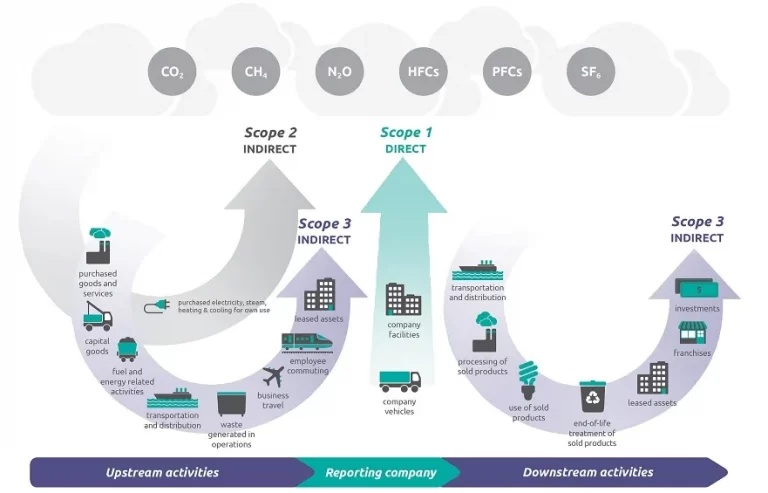
Understanding the three emission scopes helps businesses see where their carbon impact truly lies.
Each scope represents a different part of a business’s operations and value chain—from what the company directly controls to what happens beyond its walls. The table below breaks down how Scope 1, 2, and 3 emissions differ in source, control, and reduction strategy.
Looking at all three scopes together gives a complete picture of an organisation’s carbon footprint.
While Scope 1 and 2 are easier to measure and control, Scope 3 often represents the largest share, and tackling it requires collaboration across the entire business supply chain.
What Are Scope 1 Emissions and Why Are They Important?
Scope 1 emissions are direct greenhouse gases from sources a company owns or controls. This includes emissions from fuel combustion, company vehicles, boilers, and process emissions from industrial operations.
In short, Scope 1 emissions are direct GHG emissions that come from an organisation’s physical assets. These emissions are often the easiest to identify but can still be substantial, especially for manufacturing, transport, and energy-intensive businesses. Understanding Scope 1 helps companies measure and manage emissions from their core operations.
Reporting requirements vary by country and by reporting framework. In Singapore, for example, certain facilities may have mandatory reporting obligations tied to regulatory thresholds, while other organisations report Scope 1 as part of voluntary standards or investor-driven disclosures. To avoid misstatements, confirm the specific rule set that applies to your business (regulator, listing rules, or reporting standard) before stating that Scope 1 reporting is mandatory.
How Do You Measure Scope 1 Emissions?
Calculating Scope 1 emissions starts with collecting accurate activity data, such as fuel usage, mileage, or energy consumption. These values are multiplied by emission factors defined by the GHG Protocol or national agencies to estimate emissions within company boundaries.
Because Scope 1 emissions are direct, accuracy is crucial. Errors in reporting or untracked fugitive emissions from equipment can distort a company’s total emissions.
Typical categories include:
- Stationary combustion (boilers, furnaces)
- Mobile combustion (company vehicles)
- Process and fugitive emissions (leaks, refrigerants)
A detailed guide on Scope 1 measurement ensures a business can account for emissions consistently and transparently.
What Are Scope 2 Emissions and How Are They Different?
While Scope 1 and Scope 2 are often reported together in corporate reporting, they differ in terms of control and source.
Scope 2 emissions are indirect. They result from the generation of purchased energy—such as electricity, steam, heating, or cooling —that is consumed by the company.
In essence, Scope 2 encompasses indirect emissions generated outside the business’s facility but linked to its operations. Some examples are:
- Electricity is purchased from the grid to power offices, factories, or retail stores.
- Lighting and air conditioning that rely on externally supplied electricity.
- Data centres or cloud services powered by third-party electricity use.
- Purchased steam, heat, or cooling used in building operations.
- Electric vehicle (EV) charging stations on-site that draw electricity from the grid.
- Manufacturing machinery or equipment powered by bought electricity instead of on-site generation.
Although most of these emissions occur at a power plant, they’re part of a business’s carbon footprint because it uses that energy.
Scope 2 emissions are indirect GHG emissions that can represent a significant portion of an organisation’s footprint.
To reduce and manage Scope 2 emissions, many companies focus on improving energy efficiency and sourcing renewable electricity. This can include renewable electricity procurement and instruments such as Renewable Energy Certificates (RECs) or Energy Attribute Certificates (EACs), where applicable, to support renewable electricity claims and market-based Scope 2 reporting. Carbon offsets are a separate tool used to compensate for residual emissions and should be described separately from renewable electricity sourcing.
Measuring Scope 2 Emissions: Location-Based vs Market-Based Methods
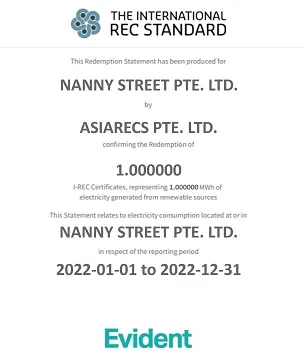
To measure Scope 2 emissions, the GHG Protocol outlines two complementary methods:
- Location-based method: Reflects the average grid-emission factor for the location where electricity is consumed.
- Market-based method: Uses supplier-specific and contractual instruments (e.g., EACs/ RECs), where eligible, to reflect the emissions associated with purchased electricity.
Each method captures the extent to which indirect emissions from electricity generation contribute to a company’s total emissions.
For transparency, it’s best to report Scope 2 using both the location-based and market-based methods to show how grid factors and electricity procurement choices influence reported emissions.
What Are Scope 3 Emissions and Why Do They Matter Most?
Scope 3 emissions include all other indirect emissions that occur in a company’s value chain. These cover both upstream and downstream emissions, including raw material extraction, supplier activities, logistics, business travel, product use, and end-of-life disposal.
Scope 3 emissions can represent over 90% of a company’s total (Scope 1, 2 and 3) emissions, depending on the industry and business model. Scope 3 is often the broadest and most complex to measure and manage, so it is a key focus area for prioritising reduction efforts.
Although these emissions occur outside a company’s direct control, they still reflect the organisation’s wider carbon footprint. Measuring Scope 3 emissions involves extensive data collection and coordination across suppliers, customers, and partners.
How to Calculate and Report Scope 3 Emissions
Calculating Scope 3 emissions starts with mapping value-chain activities and choosing from the 15 categories defined by the GHG Protocol.
For example, upstream emissions might include production and transport of raw materials, while downstream emissions involve product distribution, usage, and disposal.
Scope 3 includes all other indirect emissions that occur beyond the operations—data often sourced through estimates or supplier questionnaires. Because these emissions are often harder to track, companies use spend-based or activity-based calculations to approximate them.
When a business reports Scope 3 emissions, it aligns with the GHG Protocol’s Scope 3 reporting standards. Transparent disclosure of Scope 3 emissions measurement demonstrates the business’s commitment to comprehensive climate responsibility.
Challenges Associated with Scope 3 and Data Quality
The biggest challenges associated with Scope 3 emissions include data quality, boundary-setting, and supplier cooperation. Because Scope 3 emissions typically come from sources beyond direct control, consistent methodologies are key.
Some businesses struggle to measure their emissions accurately due to limited supplier data or inconsistent reporting systems. However, using digital tracking tools, verified emission factors, and the GHG Protocol’s calculation guidance can improve reliability.
Ultimately, understanding the full emissions landscape means accepting uncertainty but striving for transparency. When companies report on all scopes, they signal accountability across their value chain.
How Can Companies Reduce Their Scope 1, 2, and 3 Emissions?
Reducing emissions across the scopes requires a systematic approach.
For Scope 1, focus on reducing emissions from fuel combustion. Switch to low-carbon fuels, upgrade equipment, and fix leaks causing fugitive emissions.
For Scope 2 and Scope 3, strategies involve shifting to renewable energy, improving efficiency, and reducing Scope 3 emissions through supplier collaboration. Companies that reduce their scope impacts often partner to innovate in materials, logistics, and circular design.
Investing in renewable power not only reduces Scope 2 emissions but also improves the emissions intensity ratio—an essential metric for year-over-year progress.
Understanding Scope 1, 2 & 3 Is Critical for Corporate Sustainability
Understanding Scope 1, 2, and 3 emissions forms the foundation of any sustainability strategy. Together, they reveal where emissions occur, how they connect to operations, and where reduction efforts are most effective.
Businesses can cut emissions, lower costs, and build credibility by managing all three scopes. Partnering with Asiarecs SG supports this goal through Renewable Energy Certificates (RECs) that help offset Scope 2 emissions and demonstrate a verified commitment to clean energy.
By following the GHG Protocol and integrating Asia RECs SG’s RECs, RECs SG enables transparent reporting and long-term sustainability progress.