Singapore issued around 387,000 International Renewable Energy Certificates (I-RECs) in 2024, while buyers redeemed around 3.8 million. That gap gives procurement teams a clear constraint to plan around, although the published 2024 data does not show the issuing country of each certificate redeemed in Singapore.
Screenshot from external source for reference | |
“387,000 International Renewable Energy Certificates (I-RECs) in 2024, while buyers redeemed around 3.8 million” Page 21 of the PDF | 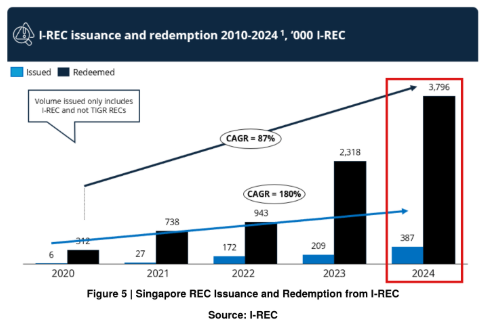 |
I-TRACK began publishing country-of-issuance data for redemptions from June 2025, applied prospectively. Until that detail is available for earlier activity, buyers can use the 2024 totals as a planning baseline and define origin, technology, vintage and timing early in the sourcing brief.
So how should a Singapore buyer turn that supply gap into a workable sourcing plan?
Key Takeaways
- Singapore issued around 387,000 I-RECs in 2024 and redeemed around 3.8 million, so same-year domestic issuance alone would fall well short if redemption remains near that scale.
- The 2024 totals show a large difference between local issuance and redemption, while certificate origin for each redeemed unit remains unavailable from those totals alone.
- Regional supply varies sharply by country, with Vietnam issuing over 12 million I-RECs and redeeming about 4 million locally during 2024.
- SS 673 expresses same-market-boundary sourcing as best practice, remains voluntary, and also covers qualifying certificates produced in Southeast Asia for renewable energy claims in Singapore.
- Buyers can plan from the wider regional pool where their reporting and internal requirements permit it, then narrow the eligible volume by origin, technology, vintage and timing.
What Singapore’s 2024 Numbers Describe
The 2024 figures are useful for planning, but they need to be read carefully:
- Issuance and redemption measure different activities: issuance records certificates created from eligible generation, while redemption records certificates used for a claim.
- The volume gap is significant: Singapore issued around 387,000 I-RECs in 2024 and recorded around 3.8 million redemptions.
- Domestic supply is naturally constrained: Singapore’s renewable generation base is limited and largely solar.
- Vintage matters: certificates redeemed in 2024 may have been generated in a different period, so the figures are not a one-to-one match.
- For sourcing: relying only on newly issued Singapore volume would have created a substantial supply constraint.
The next step is to compare Singapore with nearby markets where issuance volumes are much larger.
How The Rest Of Southeast Asia Compares

I-REC data shows a clear supply imbalance between Southeast Asian markets such as Vietnam and Singapore. Vietnam, Malaysia and Thailand recorded issuance volumes materially above Singapore’s domestic issuance; Singapore issued only about 0.4 million I-RECs in 2024, while its redemption volume substantially exceeded domestic issuance.
Screenshot from external source for reference | |
I-REC data shows a clear supply imbalance between Southeast Asian markets such as Vietnam and Singapore | Source: Page 20 and 25 of the PDF. |
“Vietnam, Malaysia and Thailand recorded issuance volumes materially above Singapore’s domestic issuance” | 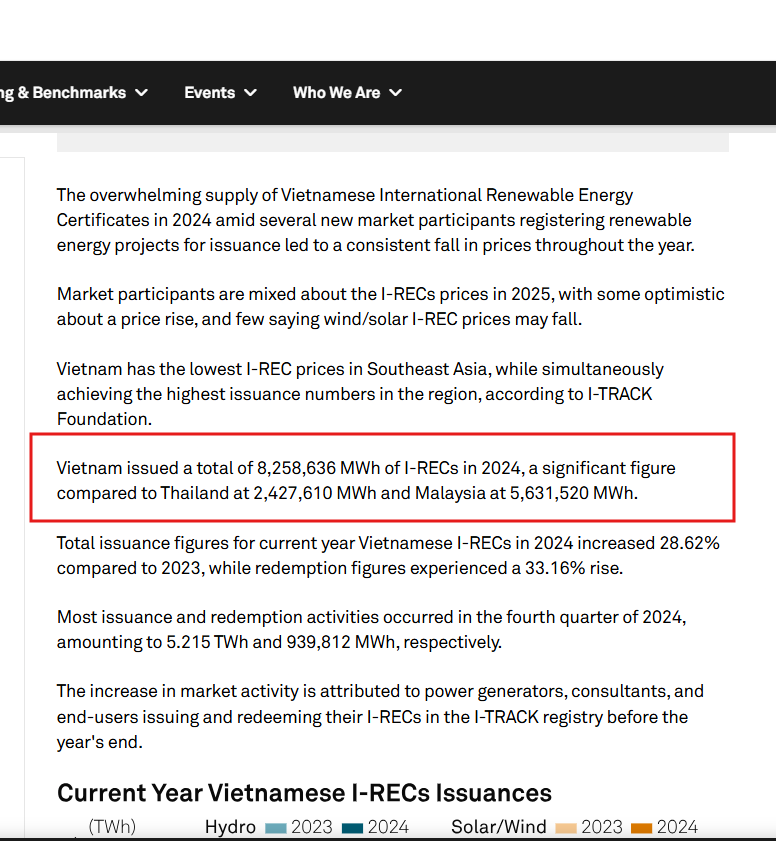 |
“ Singapore issued only about 0.4 million I-RECs in 2024, while its redemption volume substantially exceeded domestic issuance.” Page 21 of the PDF | |
For buyers, however, regional volume should not be treated as one interchangeable pool. Country balances, technology mix and vintage vary, while reporting rules, internal policy and contractual criteria determine which markets are actually eligible.
A Singapore buyer considering regional RECs should therefore record the country of issuance alongside technology, vintage and volume before approval begins. Total supply is only the first filter; technology and other sourcing criteria can narrow the usable pool further.
Technology Preferences Reduce The Eligible Pool
Headline issuance volumes show the total pool, but technology preferences quickly narrow what is usable. A buyer specifying solar or wind is working with a smaller subset, and country or vintage requirements can reduce it further.
In Singapore, domestic issuance is already limited and largely solar. Regional sourcing expands the available pool, but technology still needs to be checked against the approved criteria.
A procurement brief should therefore define origin and technology before volume is requested. A certificate may sit within the regional total yet still fall outside the eligible pool if one attribute does not match.
The next filter comes from Singapore’s national standard.
What SS 673 Expects
SS 673 is Singapore’s national Code of Practice for Renewable Energy Certificates. It provides guidance on the production, tracking, management and use of RECs for renewable energy claims.
Key points for buyers include:
- Current standard: The Singapore Standards eShop lists SS 673:2021+C1:2021 as the current edition.
- Voluntary framework: SS 673 is voluntary and recommends same-market-boundary sourcing as best practice.
- Regional scope: Qualifying RECs produced in Southeast Asia can also be used for renewable energy claims in Singapore.
- Draft amendment: A proposed update on market-based Scope 2 claims and physical deliverability is still in draft, so the current edition remains the published standard.
- Buyer criteria still apply: Your reporting framework, internal policy and other commitments determine which certificates your organisation can use.
This leaves procurement teams with a practical question: which markets, technologies, vintages and volumes should be included in the next sourcing brief?
What This Changes In Your Sourcing Plan